Introduction
This first Sunday in August is traditionally known as Lammas-tide. Lammas comes from the term ‘loaf mass’. Traditionally in Celtic times, it was a bad idea to harvest your grain any time before Lammas because it meant that the previous year’s harvest had run out early. However, on August 1st the first sheaves of grain were cut by the farmer, and by nightfall his wife had made the first loaves of bread from the first of the season’s wheat crop. A loaf was then brought into church to be used for the Communion bread. It was a day of thanksgiving, so no surprise that today’s gospel reading features the theme of bread.
When we look at the gospels it is always interesting to see which stories get mentioned by all 4 writers and which ones don’t. Only Matthew and Luke include the stories of Jesus birth, so, if it were down to Mark and John we wouldn’t have much about Christmas at all. John, on the other hand includes the raising of Lazarus, (a pretty major miracle event) and yet for one reason or other Matthew, Mark and Luke leave it out.
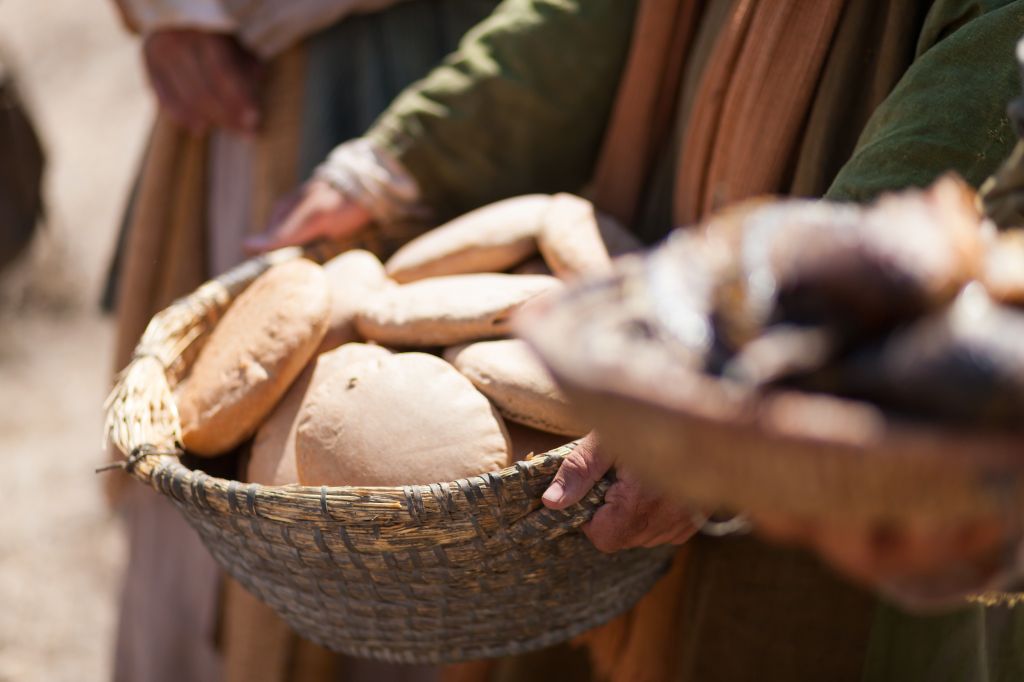
But the one thing all 4 writers include is the story of the feeding of a crowd of over 5,000 people…
So, I wonder why they did this?
Well, I am guessing that when Matthew, Mark, Luke and John were pondering how to tell the story of Jesus they had to weigh up what to leave in and what to leave out, I am sure that none of them had the time or space to share everything they heard and remembered, yet this particular story was one that they all wanted to share.
Perhaps first and foremost because it’s about food…
Food evokes feelings…
I remember several years ago reading a piece from an estate agent who said that one of the best ways of selling your house is to put bread in the oven just before potential buyers arrive, the smell of baking makes the house feel warm and welcoming.
Food also evokes memories…
A special meal out,
A romantic dinner for two,
A birthday party.
The Christmas dinner… even the one where the sprouts got burnt!!
Food evokes stories…
The first readers of the gospels would have been raised on stories of how God freed their ancestors from slavery in Egypt, and when they were in the wilderness God gave them food every day, Manna they called it, bread from heaven.
Other readers would remember the time when Jesus was at table with his disciples he took bread and broke it and gave it to them saying ‘This is my body given for you; do this and remember me’, just as we will be doing a little later on…
So, this story of the loaves and fishes is brimming with history and connection, reminding us that not only is God moved by human needs, but he is also able to meet human needs. When God promises life in all its fullness, we have good reason to take God seriously. 5,000 men not counting the women and children all fed from 5 loaves and 2 fish with enough left over to fill 12 baskets. It’s a miracle and perhaps we ought to leave at that!
However (and you just knew there was going to be a however) miracles do tend to nag at those of us who don’t experience them very often. We tend to wonder about the details.
Did Jesus multiply the loaves all at once or did it happen as the loaves were being handed through the crowd?
As someone tore off a hunk did the loaf suddenly grow bigger?
Or did new loaves appear when no one was looking?
How EXACTLY did it happen?
Matthew doesn’t tell us. What he does tell us is that this miracle happened in a lonely/ deserted place where Jesus had gone to be alone, after he heard the terrible news that his cousin John the Baptist had been murdered.
But when the crowds discovered where he was, they followed him on foot from the towns. He may have needed to be alone, but they also had their own needs. They were sick, sad, and now they were hungry too. Anyone but the Son of God might have told them to get lost, but Jesus had compassion on them, his heart went out to them.
So, when evening came the disciples found him and suggested that he send everyone away to buy supper in one of the nearby villages. They meant no harm; they were simply being practical. It was time to call it a day, to build a campfire and eat the little bit of the food they’d brought with them. It was time to take care of themselves for a change and suggest that everyone else did the same. But Jesus had a better idea. “They need not go away!” he said, “YOU give them something to eat.”
I wish I could have been there, don’t you? I wish I could have seen how they looked at each other when he said that. Give them something to eat? What US?
You’re in charge here, Jesus; you’re the boss. What do you mean, we should give them something to eat? All we have between us is five loaves and two salt fish. There are five thousand people out there, Jesus. No disrespect intended, but you’re not making any sense.
He may not have been making sense, but then again, he may have had a sense of the situation that went beyond the disciples’ “common sense”.
They were, after all, operating out of a sense of scarcity. They looked at the crowd, saw no picnic baskets or backpacks, and assumed that no one had anything to eat. They looked at their own meagre resources and assumed that it wasn’t enough to go around their own circle, much less to feed the whole crowd.
But Jesus operated out of a different set of assumptions. If the disciples operated out of a sense of scarcity, Jesus operated out of a sense of plenty. He looked at the same things the disciples looked at, but where they saw not enough, he saw plenty
Plenty of time, plenty of food, and plenty of possibilities with the resources at hand.
Not that he knew exactly how it was all going to work. He was human, remember, as well as divine— but what Jesus knew beyond a shadow of a doubt was that wherever there was plenty of God, there would be plenty of everything else. So, he asked the disciples to bring their food to him, and he ordered the crowd to sit down on the grass, and he proceeded to bless five loaves and two fishes in front of them all, perfectly confident that God would turn ‘not enough’ into plenty.
Can you imagine what it must have been like? To be sitting in that crowd, watching a rabbi bless five loaves, and break them, and give them to his disciples to give to a crowd that went on forever?
Unless you were on the front row, chances are you might not have seen it at all. You might have had to nudge your neighbour and say, “What’s going on up there?” and he might have said, “You’re not going believe it—that Jesus fellow just said grace over five loaves and two fish and now some of his men are passing them out through the crowd. It’s the craziest thing I’ve ever seen, but don’t get too excited— it’ll all be gone before it ever gets to us.”
Some of the crowd must have laughed out loud, others would have been mystified, still others were embarrassed for Jesus, that he should have promised so much with so little to deliver.
But I wonder if some of them weren’t also moved. I wonder if they didn’t look at that small basket going around and feel the food hidden in their own pockets beginning to burn a hole.
Because they remembered that bit of lamb wrapped in a grape leaf, a few raisins, a chunk of bread left over from breakfast. Something they had tucked away before heading out on foot to a lonely place. Wouldn’t you have done the same?
But it wouldn’t have been enough to share, so chances are they kept it hidden— wrapped in a handkerchief, stuffed up a sleeve—waiting for an opportune moment to go off alone and have a sneaky bite. And it might have worked, if that bread-basket hadn’t come around, full of scraps, everyone so careful not to break off too much, everyone wanting Jesus’ crazy idea to work. So much so, that very carefully, very secretly, they began to put their own bread in the basket, reaching in as if they were taking some out but leaving some behind instead, so that the meal grew and grew…
And in the end when the disciples collected the broken pieces, they stared in amazement at 12 baskets full of bread—of all kinds that started off with 5 blessed and broken loaves.
But that’s not a miracle Rose! Isn’t that what you’re thinking? That’s just human beings being generous, sharing what they have—even when it is not much, even when it is not enough to go around.
That’s not a miracle! That’s just people refusing to play the age-old game of what’s-mine-is-mine-and-what’s- yours-is-yours. People turning their pockets inside out for one another without worrying what’s in it for them.
That’s not a miracle!…… Or is it?
The problem with miracles is we tend to get mesmerized by them, focusing on God’s responsibility and forgetting our own. Miracles let us off the hook. They appeal to the part of us that’s all too happy to let God feed the crowd, save the world, do it all.
What we have to offer is not enough to make any difference anyway, so we just hold back and wait for a miracle, looking after our own needs and looking to God to help those who can’t help themselves. If Jesus is in charge of the bread, doesn’t that excuse us from sharing our own? God will provide; let God provide.
And for ‘bread’ we can also read: Our talents, our energy, time, and commitment.
“Send the crowds away,” the disciples say, “So they can buy food for themselves. “They need not go away,” Jesus replies, “You give them something to eat.”
Not me but YOU; not my bread but YOURS.
Not sometime in the future or somewhere else but RIGHT HERE AND NOW!
Stop looking for someone else to solve the problem and solve it yourselves.
Stop waiting for food to fall from the sky and share what you have.
Stop waiting for a miracle and participate in one instead…….
When it comes to the loaves and fishes, no one knows how it really happened. Your guess is as good as mine. I’ve no doubt that had he chosen Jesus could have fed that crowd from scratch with nothing at all, all by himself. But he didn’t chose.
And what Jesus says to his followers here he continues to say to us today: “They need not go away; you give them something to eat.” And if those words strike fear in our hearts, (because the loaves that we have seem like nothing at all), we have only to remember what he says next: “Don’t be scared, just bring them to me.”
Preached on Sunday August 6th 2023 at St Andrew’s Corton Denham. Thoughts inspired in part by The problem with miracles. The seeds of Heaven preaching the Gospel of Matthew by Barbara Brown Taylor


Checked in the Website, happy now ensconced there.
More hug (our garden is full of baby swallows. Where is the summer?)
S
LikeLike